
You might recognise Keanu Reeves as Neo or John Wick before you picture him holding a bass guitar. That creates an interesting naming problem: would you name the actor after a character's fearlessness, or look for something that connects his work away from the screen?
A name built for an action hero might miss the musician who listens for space in a song, or the collaborator who helps imagine a new world. To find a better starting point, we will follow those public examples before choosing a surname and three different directions for the given name.
These are SoulName's proposals, not names Reeves has adopted or endorsed. We have not interviewed him or run a personal Naming Agent consultation on his behalf. His own preferences would matter more than any editor's interpretation.
Start with the person beyond the film role
Reeves is the actor associated with the Matrix and John Wick films, but his public creative work also includes playing bass in Dogstar and collaborating with China Miéville on The Book of Elsewhere. The book offers another side of his creative work beyond the screen. Publisher's book page
There is a current musical context, too. As checked on September 28, 2026, Dogstar's official website is promoting All in Now. In a July 20, 2026 interview, Reeves describes bringing recorded bass ideas to his bandmates and developing the music together. He also explains making room in his playing when the guitar takes a solo. These are concrete descriptions of craft and ensemble work, rather than evidence about his private personality. Bass Magazine interview
That changes our brief. Instead of translating an action hero into dramatic characters, we have three possible priorities: practising a craft, contributing to a group, and exploring imagined worlds. None tells us everything about him. Each gives a different name a defensible starting point.
Choose the surname before decorating the given name
We will use Li (李, Lǐ) as an editorial surname choice. It is an established Chinese surname; the character also has the dictionary meaning “plum.” We are using its surname function, not claiming a plum-tree connection to Reeves's ancestry or personality. Dictionary entry for Li
This choice prioritises a compact, recognisable surname over preserving the sound of Reeves. A surname such as Li (黎, Lí) would produce a different written identity and tone even though an English transcription drops that distinction. We prefer 李 here because its third tone gives the first two candidates a clear change of pitch. That is an editorial sound preference, not proof that it is his ideal surname.
If retaining the sound or history of Reeves were his priority, we would reopen the surname decision before choosing a given name. A meaning-led personal name and a media transliteration serve different purposes; one need not replace the other. Our guide to choosing a Chinese surname explores that first decision.
Three directions, with a reason to choose each
Li Zhixing: learning that becomes action
李知行 · Lǐ Zhīxíng
知 (zhī) concerns knowing or understanding; 行 (xíng) can mean acting or carrying something out. Our whole-name reading is “a person who brings understanding into practice.” This is an interpretation of the combination, not a literal English sentence hidden inside the name. Zhi · Xing
Why begin here? The public example is a musician working from an idea toward something playable with a band. The name can point to that process without tying him permanently to a single instrument or fictional role.
The trade-off is its earnest, reflective tone. It may feel more like a guiding principle than a playful stage name. 行 also has multiple readings: we intend xíng, not háng. Someone encountering the name for the first time may need that pronunciation clarified.
Choose this direction if the brief is about craft across different kinds of work.
Li Heming: a voice that belongs in the ensemble
李和鸣 · Lǐ Hémíng
Here 和 (hé) means harmony or coordination, while 鸣 (míng) refers to sounding or calling. We read the combination as “contributing a voice in harmony with others.” The selected reading is hé; 和 has other readings in other contexts. He · Ming
The reason for this candidate is specific: leaving sonic space for another musician makes a more useful naming clue than a vague label such as “nice.” It suggests a way of working in an ensemble. It does not prove that Reeves is agreeable in every part of his life.
This is the most musical option. That is also its limitation: if he wanted a name with no obvious link to his public career, its resonance with sound might be too prominent. We would avoid the more literal Hexian (和弦, chord) for this brief because it reads too directly as a musical term.
Choose this direction if collaboration is the quality the name should foreground.
Li Siyuan: thought with room to travel
李思远 · Lǐ Sīyuǎn
思 (sī) relates to thought; 远 (yuǎn) means far or distant. Our editorial reading is “thought that reaches beyond the immediate horizon.” That is a metaphor for imagination, not a claim about exceptional intelligence or supernatural foresight. Si · Yuan
The creative-world collaboration behind The Book of Elsewhere gives this direction its starting point. A name can leave space for invention without literally naming a film, a comic or a book.
The trade-off is distinctiveness. This combination is already used by other people, including a researcher listed by the Chinese Academy of Sciences; these proposals are not exclusive identities. It also says less about hands-on practice than Zhixing. We would choose it only if an open, imaginative meaning mattered more than a close connection to everyday craft.
Choose this direction if the name should feel spacious rather than occupational.
Read the complete names, not just attractive characters
All three retain the same surname so that the change of emphasis is easy to hear. In Mandarin, the citation tones are 3–1–2 for Lǐ Zhīxíng, 3–2–2 for Lǐ Hémíng and 3–1–3 for Lǐ Sīyuǎn. English sound hints such as “lee-jrr-shing” are only rough aids; they do not replace the tones or a Mandarin speaker's pronunciation.
In our editorial review of the Mandarin readings, none of these combinations formed an obvious insulting phrase. That is a limited review, not a guarantee across dialects, accents or every social setting. Exact-name searches also cannot establish uniqueness. A real consultation would add the person's preferred sound, intended use, cultural associations and reaction when addressed by each name.
Three name cards to compare
Three Chinese name proposals
These are SoulName editorial proposals inspired by public information about Keanu Reeves. They are not names chosen, used, or endorsed by Keanu Reeves.
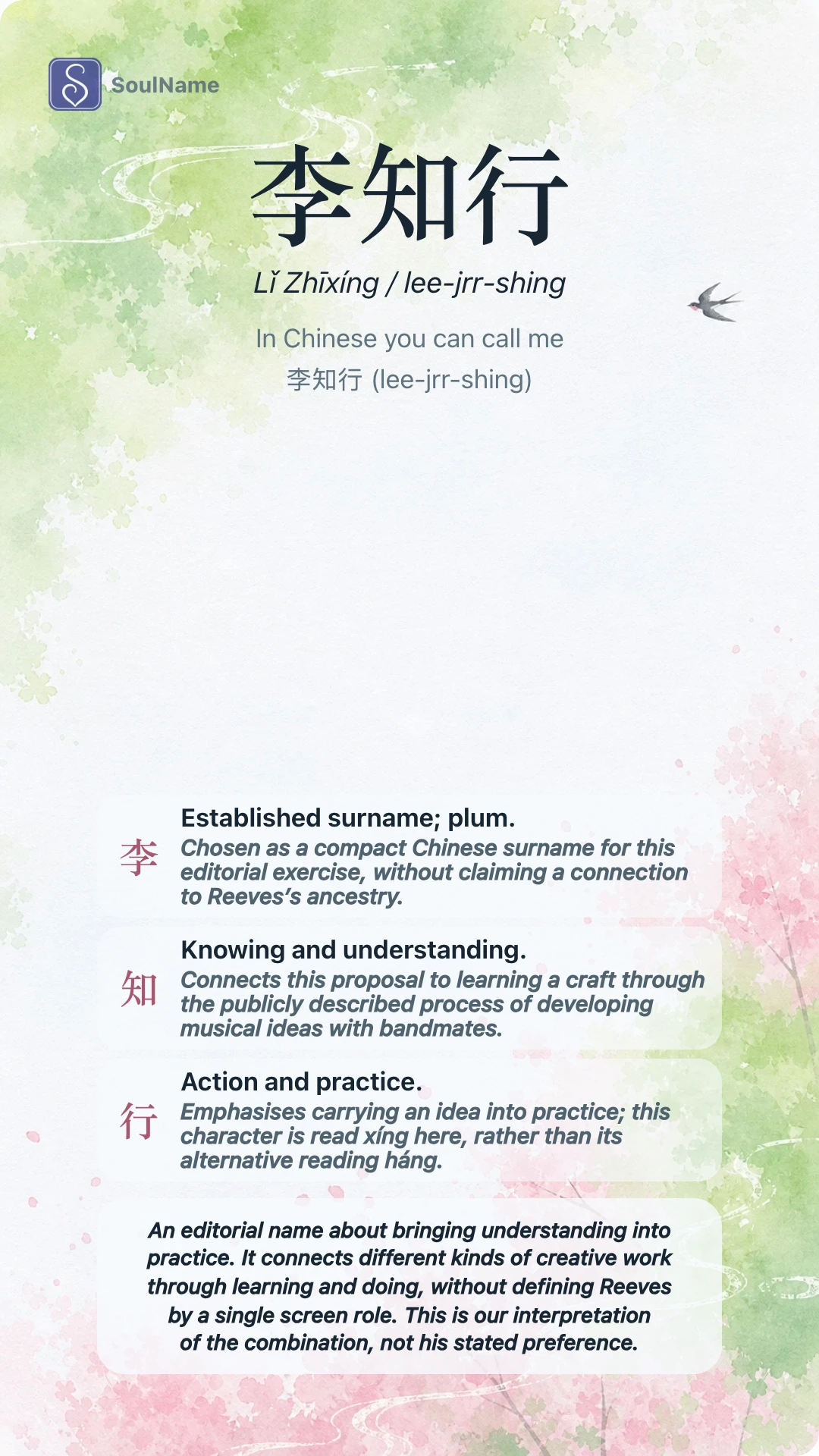
Read the full explanation for Lǐ Zhīxíng
李知行 · Lǐ Zhīxíng
- 李 — Established surname; plum
- Chosen as a compact Chinese surname for this editorial exercise, without claiming a connection to Reeves’s ancestry.
- 知 — Knowing and understanding
- Connects this proposal to learning a craft through the publicly described process of developing musical ideas with bandmates.
- 行 — Action and practice
- Emphasises carrying an idea into practice; this character is read xíng here, rather than its alternative reading háng.
Whole-name meaning: An editorial name about bringing understanding into practice. It connects different kinds of creative work through learning and doing, without defining Reeves by a single screen role. This is our interpretation of the combination, not his stated preference.
Trade-off: Earnest and reflective; 行 needs the intended reading xíng clarified. This may feel more like a guiding principle than a playful stage name.
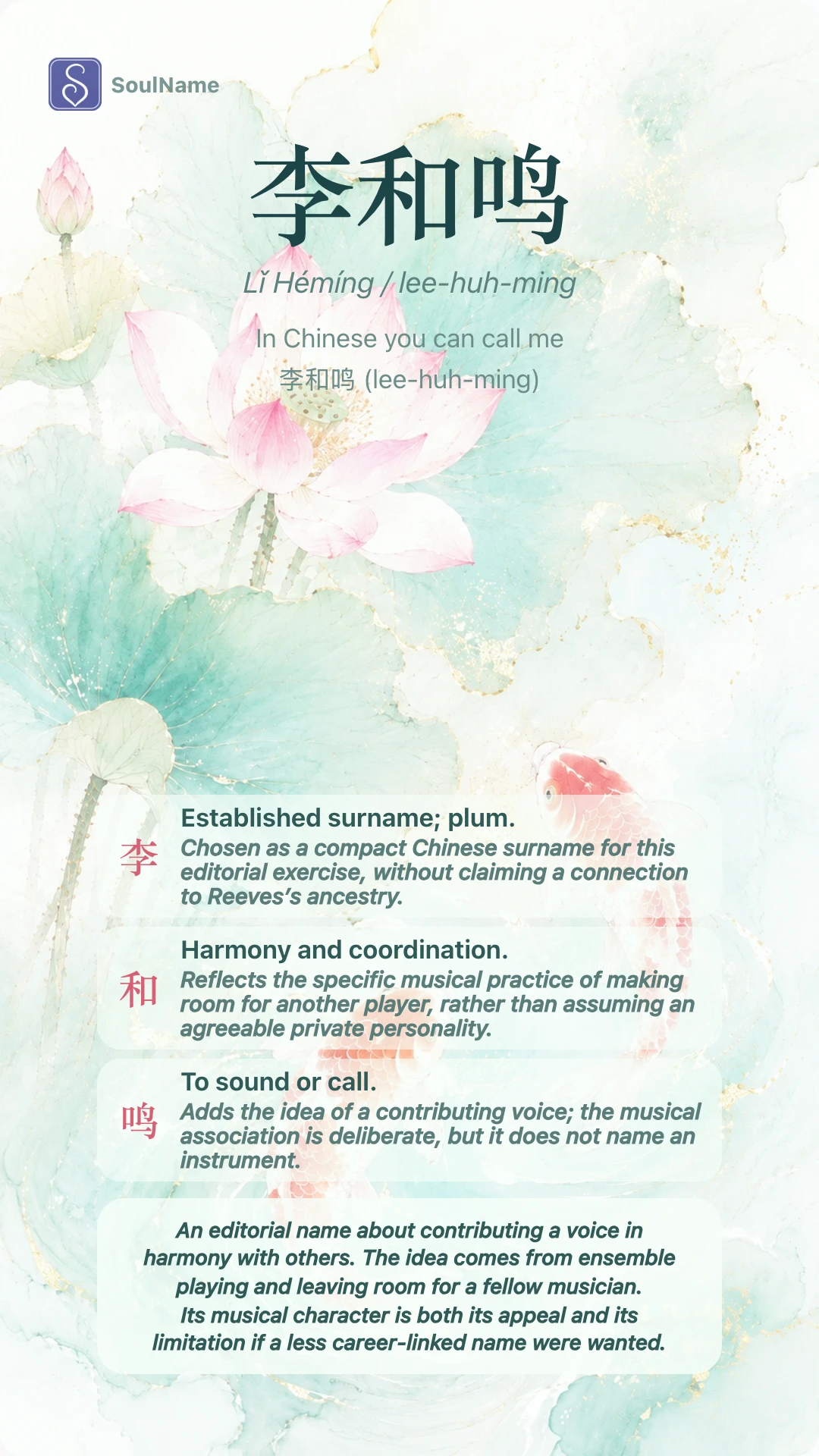
Read the full explanation for Lǐ Hémíng
李和鸣 · Lǐ Hémíng
- 李 — Established surname; plum
- Chosen as a compact Chinese surname for this editorial exercise, without claiming a connection to Reeves’s ancestry.
- 和 — Harmony and coordination
- Reflects the specific musical practice of making room for another player, rather than assuming an agreeable private personality.
- 鸣 — To sound or call
- Adds the idea of a contributing voice; the musical association is deliberate, but it does not name an instrument.
Whole-name meaning: An editorial name about contributing a voice in harmony with others. The idea comes from ensemble playing and leaving room for a fellow musician. Its musical character is both its appeal and its limitation if a less career-linked name were wanted.
Trade-off: The most musical option; its career association may be too prominent if a less occupational name is wanted.
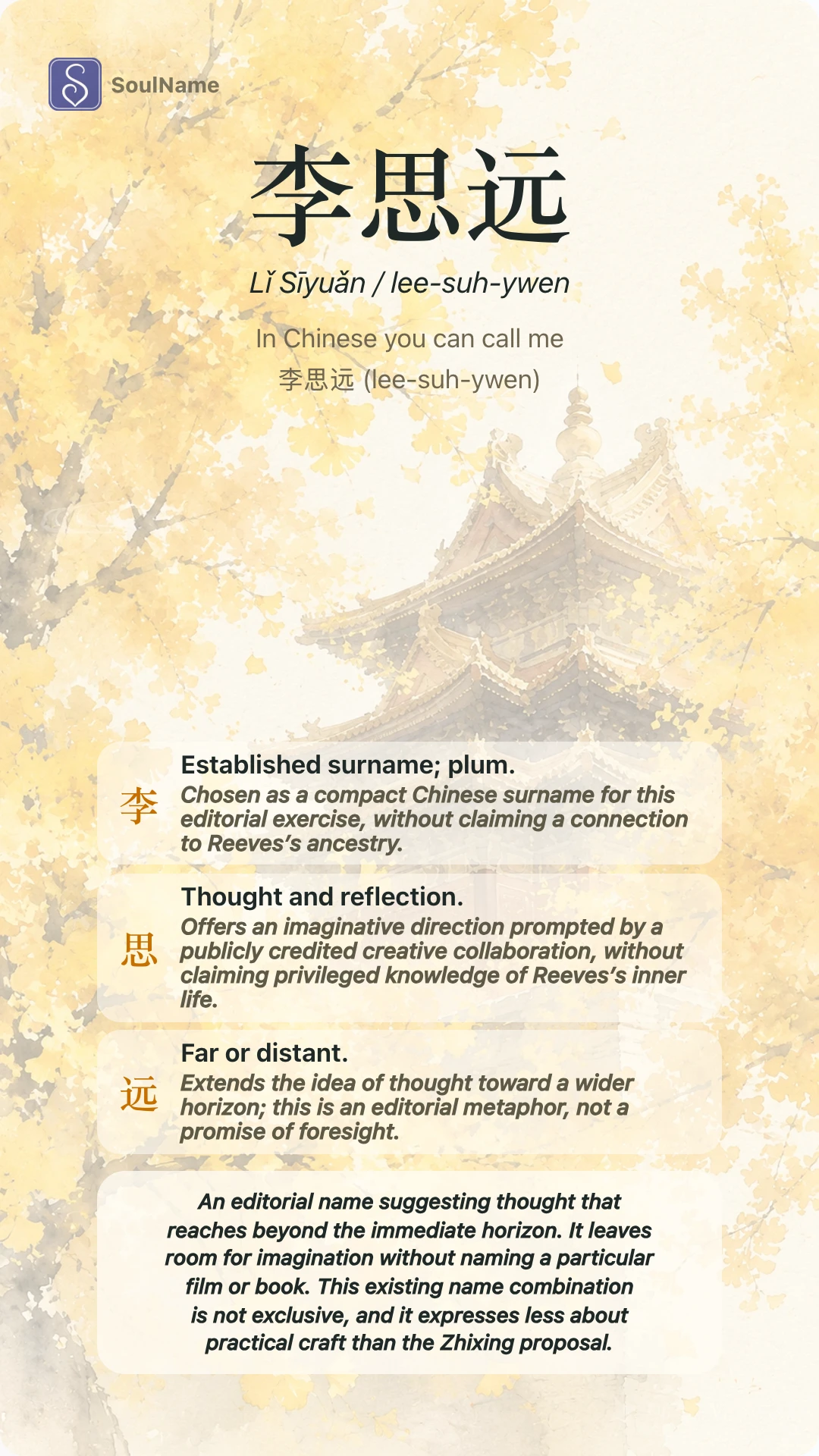
Read the full explanation for Lǐ Sīyuǎn
李思远 · Lǐ Sīyuǎn
- 李 — Established surname; plum
- Chosen as a compact Chinese surname for this editorial exercise, without claiming a connection to Reeves’s ancestry.
- 思 — Thought and reflection
- Offers an imaginative direction prompted by a publicly credited creative collaboration, without claiming privileged knowledge of Reeves’s inner life.
- 远 — Far or distant
- Extends the idea of thought toward a wider horizon; this is an editorial metaphor, not a promise of foresight.
Whole-name meaning: An editorial name suggesting thought that reaches beyond the immediate horizon. It leaves room for imagination without naming a particular film or book. This existing name combination is not exclusive, and it expresses less about practical craft than the Zhixing proposal.
Trade-off: Already used by other people and not exclusive; it says less about hands-on craft than Zhixing.
Which one would we recommend?
For the public-work brief we set at the start, Li Zhixing is our first proposal because it connects learning with action without reducing Reeves to a film role or instrument. If the brief changed to “celebrate playing with other people,” we would choose Li Heming. If imaginative scope came first, Li Siyuan would move ahead.
The useful lesson is the order of the decision: start with an evidenced quality and the person's preferences, choose a surname deliberately, then compare complete names. A beautiful character is not yet a reason to give someone a name. If you are choosing your own, start a SoulName conversation with what you want people to hear in it.