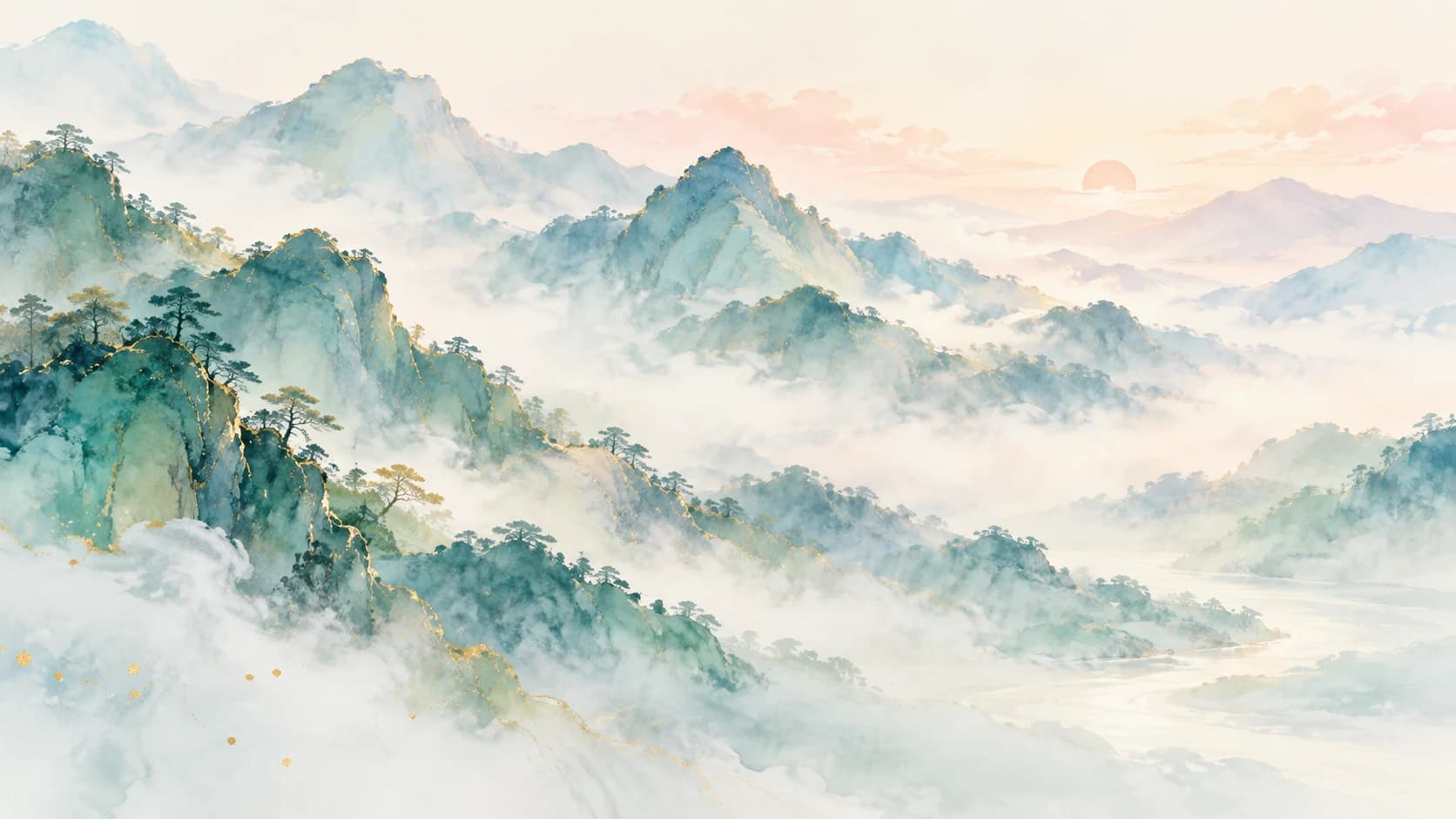
Start with the scene you want to carry in your name: a clear river, a pine tree, a cloud-covered peak, or rain feeding new growth. 清川 Qīngchuān names a visible landscape; 松宁 Sōngníng combines a tree with a wish for peace. Those are different ways to make a nature-inspired Chinese name meaningful.
Fourteen examples help you choose a direction: six landscape starting points, three moon and sky choices, and five spring or growth names. Focused rain and light collections extend the comparison. They are editorial proposals for comparison, with Mandarin pronunciation and sample full names. Landscape imagery is open to anyone; the style guides linked below describe different presentations, rather than deciding who may use a name.
Choose a scene first
For a river, clear water, or waves, start with water-inspired Chinese names. Choose this route when the kind of water matters: a river is a place, clarity is a quality, and a wave is movement.
For peaks, trees, or mountain mist, start with Chinese names inspired by mountains and forests. Choose this route when you want a particular form or plant in the name, rather than a general promise of strength.
For rain feeding new growth or a sky clearing after rain, use the 雨萌 example below to enter the weather comparison. For sunrise and brightness, compare Chinese names inspired by light and sunshine. The moon and sky and spring sections below distinguish celestial images from seasons and living things.
A clear river or quieter wave imagery?
1. 清川 · Qīngchuān
清 qīng means clear or pure; 川 chuān means river. The literal combination is a clear river. It gives you an image you can explain without turning the river into a claim about your character.
Try 沈清川 Shěn Qīngchuān. 沈 is the example surname; the landscape is in 清川. Choose it over 静澜 if you want an explicit river rather than quieter, more interpretive wave imagery. Clear water need not be motionless, so “calm personality” would be an added interpretation. The two first-tone syllables need ordinary pronunciation practice, not a theory that level tones create serenity. Compare river alternatives.
2. 静澜 · Jìnglán
静 means still or quiet; 澜 means large waves. We read the pairing as stillness associated with waves, whether as a tranquil scene or a contrast between calm and movement. Neither character specifies an ocean. The dictionary’s 波澜 entry includes 波澜不惊, showing that waves can be described as undisturbed.
Try 韩静澜 Hán Jìnglán. Choose it for quieter, more interpretive wave imagery; choose 清川 if you want an explicit river. 澜 has a more detailed written form than 川, and its traditional form is 瀾. See the wave-name comparison.
A distant peak or a tree close at hand?
3. 云峰 · Yúnfēng
云 supplies the cloud image and 峰 the mountain peak. “A peak among clouds” is the scene we draw from those meanings. Compared with 松宁, this name puts your attention on height and distance rather than a particular tree.
Try 周云峰 Zhōu Yúnfēng. Choose it when a mountain silhouette matters to you. 峰 also has a highest-point sense, but interpreting the name as a guarantee of success would go beyond the words. Keep fēng distinct from fān in 云帆: the first gives you a peak; the second a sail. Compare peak and mountain names.
4. 松宁 · Sōngníng
松 is pine; 宁 at níng means peaceful or settled. The literal ingredients are a tree and a condition of peace. Our reading is a quiet place among pines. It is a closer, less panoramic image than 云峰, and the peace is an intention you might value rather than a trait the name proves.
Try 顾松宁 Gù Sōngníng. Choose it if you want the tree named explicitly. 宁 has more than one reading; record níng with the characters when introducing this proposal. In traditional writing the peace character is 寧; the pine remains 松. Compare forest and tree names.
New growth or a journey under the sky?
5. 雨萌 · Yǔméng
雨 at yǔ means rain; 萌 can mean a bud or sprouting, and the dictionary also records its endearing sense. Rain nourishing a young shoot is our reading of the combination. The growth image supplies a concrete reason for its youthful feel; it is not an age rule.
Try 林雨萌 Lín Yǔméng, the example in the cute collection. 林 is the surname here, so do not count it as a forest meaning inside the given name. Choose 雨萌 if you enjoy a small, fresh image with an affectionate edge. If you want trees without the bud/endearing association, compare 松宁. Compare rain and clear-sky names.
6. 云帆 · Yúnfān
云 means cloud in this reading, and 帆 is a sail. The dictionary also records 云帆 as a white sail, with an extended sense of a ship. A sail beneath clouds is a useful editorial picture, but it is not the only lexical reading of this existing expression.
Try 沈云帆 Shěn Yúnfān. Choose it when your connection to nature includes movement through it: sailing, wind, and an open view. Compared with 云峰, it gives the scene a human-made object and an implied journey. The pinyin here follows the mainland Mandarin fān reading; the dictionary’s 國語 section also records fán for the sail noun. Use the pronunciation appropriate to your speaking community. See 云帆 in context.
Moon and sky images
A moon, a celestial reference, and the morning appearance of Venus are different naming choices. This small selection compares those differences without treating every sky-related character as a word for “star.” It contains three names and does not provide a star-name catalogue.
江月 Jiāngyuè — the moon beside a river
江 jiāng means a large river; 月 yuè means the moon. A moon above a river, or reflected in it, is a scene we draw from the two nouns. Neither character literally means reflection. 江, 月.
Try 许江月 Xǔ Jiāngyuè. This is the most explicit moon choice of the three. It leaves the relationship between the river and moon open, which can appeal if you want a literary scene rather than a stated personality trait. Try the full name in an everyday introduction; liking a landscape is not the same as liking it as your name.
逸辰 Yìchén — ease with a celestial reference
逸 yì includes ease or leisure; 辰 chén can refer to celestial bodies collectively, as well as time or days. Selecting ease and the celestial sense gives us the image of an unhurried sky. It does not make 辰 a precise synonym for a single star. MOE 逸, MOE 辰.
Try 方逸辰 Fāng Yìchén. Its sky image is less explicit than 江月, and explaining which sense of 辰 you intend is part of the choice. 辰 is an exact homophone of 晨, morning, but this spelling does not literally mean dawn. The source presents it in a masculine-leaning style; that is not a restriction on the wearer.
启明 Qǐmíng — the morning appearance of Venus
启 qǐ means open or begin, and 明 míng means bright or clear. Alongside a character-based interpretation of opening toward brightness, 启明 has an established use for Venus in the morning sky. 启, 明, MOE 金星: Venus and the name 启明.
Try 周启明 Zhōu Qǐmíng. Choose it if the named celestial association interests you more than a freely imagined scene. If your priority is specifically the moon, 江月 is more direct. The “morning star” description should not be presented as proof that Venus is a star.
Making the sky comparison useful
江月 supplies the moon explicitly. 逸辰 leaves the celestial reference broader. 启明 has an established astronomical association as well as a brightness-related reading. These three choices are enough for a useful section, but not evidence for an extensive list of names meaning moon and stars. Check your preferred complete name with speakers in the community where you will use it.
Explore these names: 江月 in the water comparison · 逸辰 in the cool-name comparison · 启明 in the hope guide
Spring and new growth
A spring name can name the season directly or focus on something beginning to grow. These five choices distinguish waiting for spring, mild spring weather, young grain, a flower bud, and a tree. A plant image need not imply that a person was born in spring.
待春 Dàichūn — waiting for spring
待 dài means wait; 春 chūn means spring. “Waiting for spring” is the direct scene. You can connect it to patience or hope without inventing an experience of hardship. 待, 春.
Try 沈待春 Shěn Dàichūn. It is the most narrative of these choices and may feel more like a pen name than you want in a routine introduction. Read 待 as dài here. Choose 春和 instead if you prefer a season already present to the act of waiting for it.
春和 Chūnhé — a mild spring atmosphere
春 supplies spring; 和 hé contributes mildness or warmth in this reading. The resulting picture is a mild spring day. It centres a seasonal atmosphere rather than a particular plant. 和.
Try 许春和 Xǔ Chūnhé. Compared with 待春, it feels less like a small story and more like a settled description. The source presents it in an open-gender group; no dictionary can establish universal neutrality. Keep hé as the selected reading of 和.
新禾 Xīnhé — new growth in a field
新 xīn means new; 禾 hé supplies grain or growing grain. We picture new growth in a field. It is an agricultural image rather than a flower, and neither character specifies spring. 禾.
Try 程新禾 Chéng Xīnhé. Choose it when ordinary growth appeals more than a decorative bloom. 禾 sounds like 和 and 河; 禾苗的禾 helps identify the written character. The given-name image does not depend on the surname 程.
新蕾 Xīnlěi — a new flower bud
新 means new; 蕾 lěi means a flower bud. This is the most directly floral option in the section. Growth before flowering is the visible image; future accomplishment would be an added personal interpretation. 蕾.
Try 顾新蕾 Gù Xīnlěi. The source gives it a feminine-leaning presentation. Choose it over 新禾 when you specifically want a flower rather than field growth. Keep the third tone of lěi distinct from 雷 léi, thunder, and identify the grass radical when explaining the spelling.
新桐 Xīntóng — a new tree image
新 means new; 桐 tóng names a tong tree. The combination gives renewal a tree-shaped image, but 桐 has different botanical uses in compounds. It should not be advertised as a precise species identification. 新, 桐.
Try 叶新桐 Yè Xīntóng. Choose it over 新蕾 if you prefer a tree to a flower bud. Explain 新旧的新,梧桐的桐; using 梧桐 to identify the character does not make every 桐 the same species. The source also notes the sound overlap with 心同. Showing 桐 keeps the intended tree image visible.
Season or living thing?
Start with 待春 or 春和 if the word “spring” matters. Start with 新禾, 新蕾, or 新桐 if the growing thing matters more. The last three are growth names that can belong in a spring-themed section; they do not literally mean spring. Choose the seasonal or plant image you would enjoy explaining in your own introduction.
Explore these names: 待春 in the hope guide · 春和 and 新禾 in the vitality guide · 新蕾 in the vitality guide · 新桐 in the hope guide
What changes when you choose a different image?
清川 and 静澜 can both appeal to someone who likes water, but the first describes a clear river while the second offers quieter, more interpretive wave imagery. 云峰 and 松宁 both point outdoors, but one is a distant outline and the other joins a tree to peace. 雨萌 and 云帆 both suggest a scene with movement, yet sprouting and sailing create very different personal stories.
If the image fits but the presentation does not, compare cool masculine names, bold masculine names, or elegant feminine names. A change of style should change the shortlist and the explanation, rather than merely relabel the same name.
Turn the scene into a usable shortlist
Take two candidates into an ordinary introduction with your own surname. Ask a Mandarin speaker what characters they infer before showing your preferred explanation, then check the written form and any association they mention. These editorial examples have not been tested by a native-speaker panel. Another Chinese language or regional pronunciation needs its own check.
Keep the difference between a dictionary meaning and your personal story visible. A water-related radical alone does not make every character mean water, and a sample surname does not add another given-name meaning. For a fuller practical check, use Does Your Chinese Name Sound Natural?.
Sources & Notes
Character definitions and the selected readings were checked on 7 October 2026 against the Ministry of Education entries for 清 and 川 and the Han Dian entries linked beside the other claims. The 云帆 compound entry supports the white-sail/ship senses; the separate 帆 entry shows the regional reading difference. Simplified characters are used in the candidate headings.
The comparisons—close versus panoramic, explicit river versus interpretive wave imagery, youthful growth versus travel—are editorial judgments, not dictionary definitions, popularity rankings, or claims about gender. This overview compares fourteen distinct names to help you navigate by image. Water, mountains and forests, rain and clear skies, and light and sunshine each have focused collections; moon and sky and spring and growth comparisons live here.