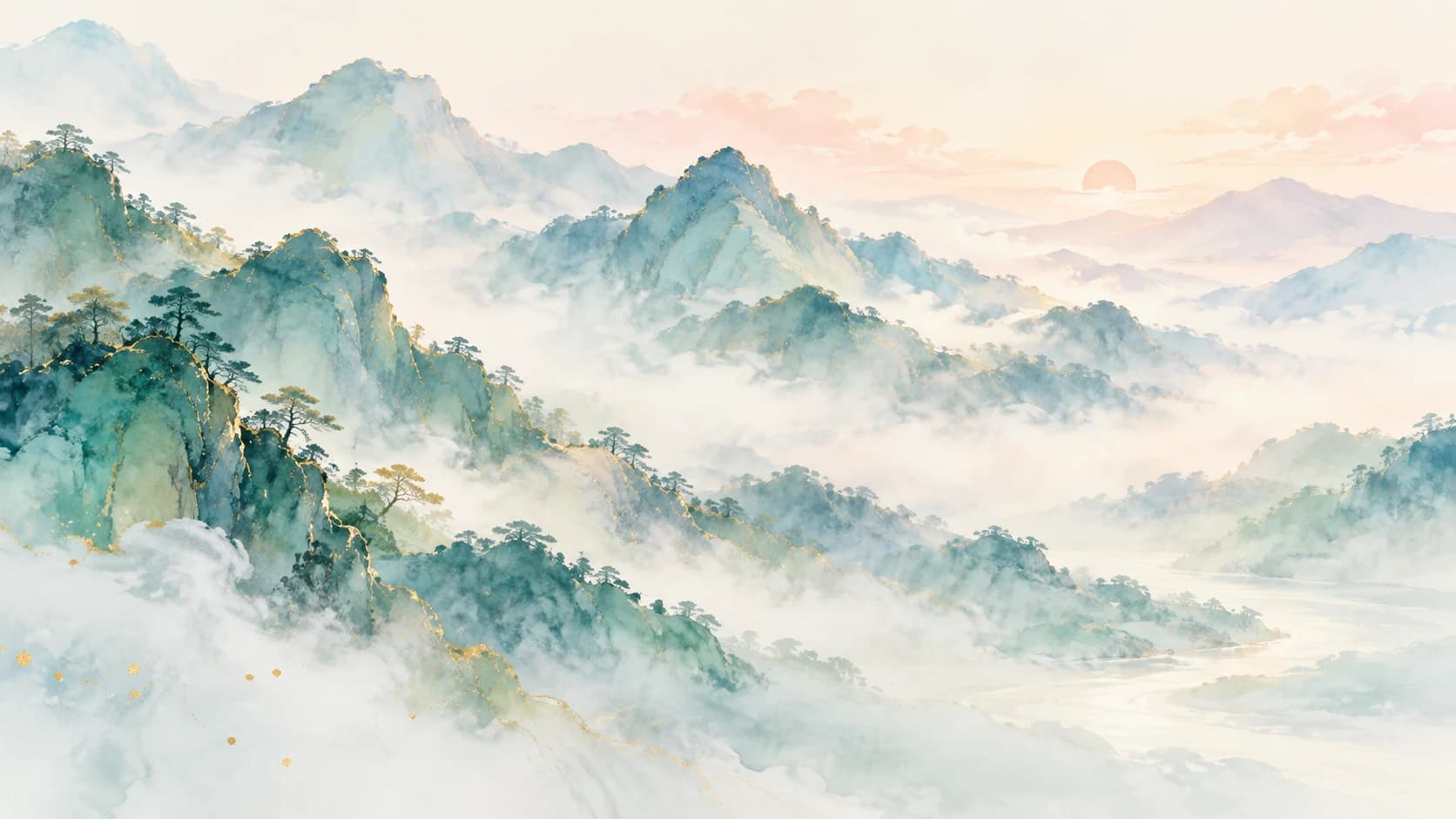
Choose 云峰 Yúnfēng for a visible summit, 松宁 Sōngníng for a pine in a peaceful setting, or 林溪 Línxī for woods beside a stream. Mountain and forest names can focus on solid landforms, living trees, or the atmosphere around them. These nine proposals help you decide which part of the landscape you want to carry into a name.
These nine given names are editorial proposals for adults choosing a Chinese name. Example full names let you test the sound; keep your own Chinese surname if you have one. Nature imagery does not determine gender, age, personality, or a name’s suitability for every speaker. Pinyin below uses the intended Mandarin readings.
Choose the picture first
For the landform: 景山 gives a broad view, 云峰 focuses on a summit, and 峻宁 adds a contrast between steepness and peace. Mountains and their outlines
For trees: 松宁 names a pine and a quiet mood, 松远 adds distance, and 林溪 brings together woods and water. Pines, woods, and a stream
For atmosphere and perspective: 岚清 centres mountain mist, 云岫 evokes cloud-wreathed peaks, and 远岑 picks out a distant hill. Mist, clouds, and distant hills
Mountains and their outlines
1. 景山 Jǐngshān — the mountain as a view
景 has a scenery sense; 山 means mountain. We read the pair as a mountain seen as part of a view. Choose Jǐngshān over Jùnníng if your starting point is the landscape rather than the steepness or severity of a slope. It is a straightforward picture with familiar characters. Han Dian: 景 Han Dian: 山
陈景山 Chén Jǐngshān moves from a rising tone through a third tone to a level ending. The written combination can also look like a place name, so test it in a complete spoken introduction. Its mountain meaning does not establish a connection to any particular mountain or hometown.
2. 云峰 Yúnfēng — a peak among clouds
云 means cloud; 峰 is a mountain peak, especially a high, pointed summit. The two nouns let us picture cloud around a peak without claiming that the complete name is an ancient quotation. Choose Yúnfēng over Jǐngshān if the summit’s outline matters more than the general view. Han Dian: 云 Han Dian: 峰
李云峰 Lǐ Yúnfēng gives a third-tone/rising-tone/level sequence with no repeated syllable. 峰 is not 锋 fēng, “sharp edge”: the sound is identical, but the chosen character keeps the image geographical. The height can feel expansive; it does not predict ambition, leadership, or success.
3. 峻宁 Jùnníng — steepness balanced by peace
峻 means high and steep, and can also mean severe; 宁 níng means peaceful or settled. Our reading puts a strong mountain contour beside a quiet quality. Choose Jùnníng if you want more contrast than Yúnfēng’s two-part scene. Han Dian: 峻 Han Dian: 宁
周峻宁 Zhōu Jùnníng goes from level to falling to rising tones. The severe sense of 峻 remains possible; 宁 does not delete it. This is a less literal landscape than Jǐngshān, and a more serious one than Línxī. For a related mountain-and-measure pairing, compare 峻衡 Jùnhéng in the cool-name collection.
See the complete example and its separate tradeoff: 峻衡 Jùnhéng.
Pines, woods, and a stream
4. 松宁 Sōngníng — pine and a peaceful setting
松 names the pine tree; 宁 níng means peaceful or settled. A pine in a quiet setting is the image we choose from those meanings. The tree is specific, unlike the collection of trees in 林. Choose Sōngníng over Sōngyuǎn if you want the mood to stay close and still. Han Dian: 松 Han Dian: 宁
许松宁 Xǔ Sōngníng has a third-tone surname followed by level and rising tones, keeping the three syllables distinct. In simplified writing 松 can also represent meanings such as loose or relaxed; the pine sense is the intended one. No tree symbolism needs to be turned into a claim about your endurance or temperament.
5. 松远 Sōngyuǎn — pine and distance
松 contributes a pine; 远 means far or distant. We picture a pine line receding into the distance, rather than translate the pair as a fixed phrase. Choose Sōngyuǎn over Sōngníng when you want space in the scene more than a named peaceful quality. Han Dian: 松 Han Dian: 远
顾松远 Gù Sōngyuǎn has a falling–level–third-tone sequence. Without tone marks, Songyuan can also represent 松原 Sōngyuán. The second character and its tone differ; introduce 远 yuǎn clearly. The combination leaves the relationship between pine and distance open; someone who prefers a more immediately visible scene may find Línxī easier to explain.
6. 林溪 Línxī — woods beside a stream
林 means a grove or woods; 溪 means a small stream, especially a mountain stream. Here 林 belongs to the given name itself. Together they let us picture water running through trees. Choose Línxī if a woodland scene matters more to you than an individual pine or a bare summit. Han Dian: 林 Han Dian: 溪
宋林溪 Sòng Línxī has falling, rising, and level tones. The surname is 宋; the two-character given name is 林溪. That structure keeps its forest meaning intact if you use a different surname. Línxī shares its pronunciation with other spellings, so show both characters when making an introduction.
Mist, clouds, and distant hills
7. 岚清 Lánqīng — mountain mist with clarity
岚 means mist among mountains; 清 carries clear or pure senses. Our reading is mountain mist opening into a light, clear atmosphere. Choose Lánqīng over Yúnfēng if you care more about the air surrounding the mountain than the summit itself. Han Dian: 岚 Ministry of Education: 清
苏岚清 Sū Lánqīng has level, rising, and level tones. In speech 岚 lán sounds the same as 兰 lán, “orchid,” so its mountain meaning depends on the written character. This is a subtle landscape choice; Jǐngshān is more direct if you want the mountain immediately visible in the explanation.
8. 云岫 Yúnxiù — cloud-wreathed peaks
云岫 is an existing expression for cloud-wreathed peaks. 岫 individually can mean a mountain cave or mountain peaks, but the compound’s recorded sense is the starting point here. Compared with 云峰, it offers a more literary word choice rather than a different landform. Han Dian: 云岫 Ministry of Education: 岫
叶云岫 Yè Yúnxiù moves from falling to rising to falling tones. 岫 xiù may need a written introduction, so this literary expression takes more explanation than 云峰. This is the most literary option in this group; consider whether you enjoy that extra explanation in ordinary use.
9. 远岑 Yuǎncén — a distant small, high hill
远 means distant; 岑 can mean a small but high mountain or hill. The scale differs from an expansive summit scene: we picture a distinct rise seen from far away. Choose Yuǎncén if that precise landform appeals to you more than the mist in Lánqīng. Han Dian: 远 Han Dian: 岑
张远岑 Zhāng Yuǎncén has level, third, and rising tones. 岑 cén needs careful pronunciation and may need spelling out; do not replace it with 沉 chén, which has a different initial and meaning. It is a more literary choice than Yúnfēng, with that extra explanation as a real tradeoff.
Try two complete names
Choose two whose differences you can explain in one sentence. Say each with your surname in a short introduction, then write it for someone who uses Chinese in the setting that matters to you. Ask what they first hear and how they would spell it. A pleasing picture is only part of the choice; homophones, local pronunciation, and your comfort repeating the name matter too.
For the other landscape direction, explore water-inspired Chinese names. The nature-inspired Chinese names overview compares the collections before you make a shortlist. For a more personal comparison process, read how to choose between Chinese name candidates.
Sources & Notes
Character and compound readings and meanings were checked against the dictionary entries linked beside each proposal on October 7, 2026. The Ministry of Education entries distinguish the relevant readings and senses; Han Dian supplies the other lexical references. Simplified characters appear in the proposals; a linked dictionary may show traditional forms. Dictionary evidence supports the words and readings, not popularity, uniqueness, gender certainty, or a claim that a complete proposal comes from an ancient text.
The scenes, comparisons, and style descriptions are our editorial interpretations. These are not results from a native-speaker panel or a personalized naming-agent run. Full-name examples are illustrative; no connection to a real person is implied. Local pronunciation and individual fit need a fresh check with your complete name.