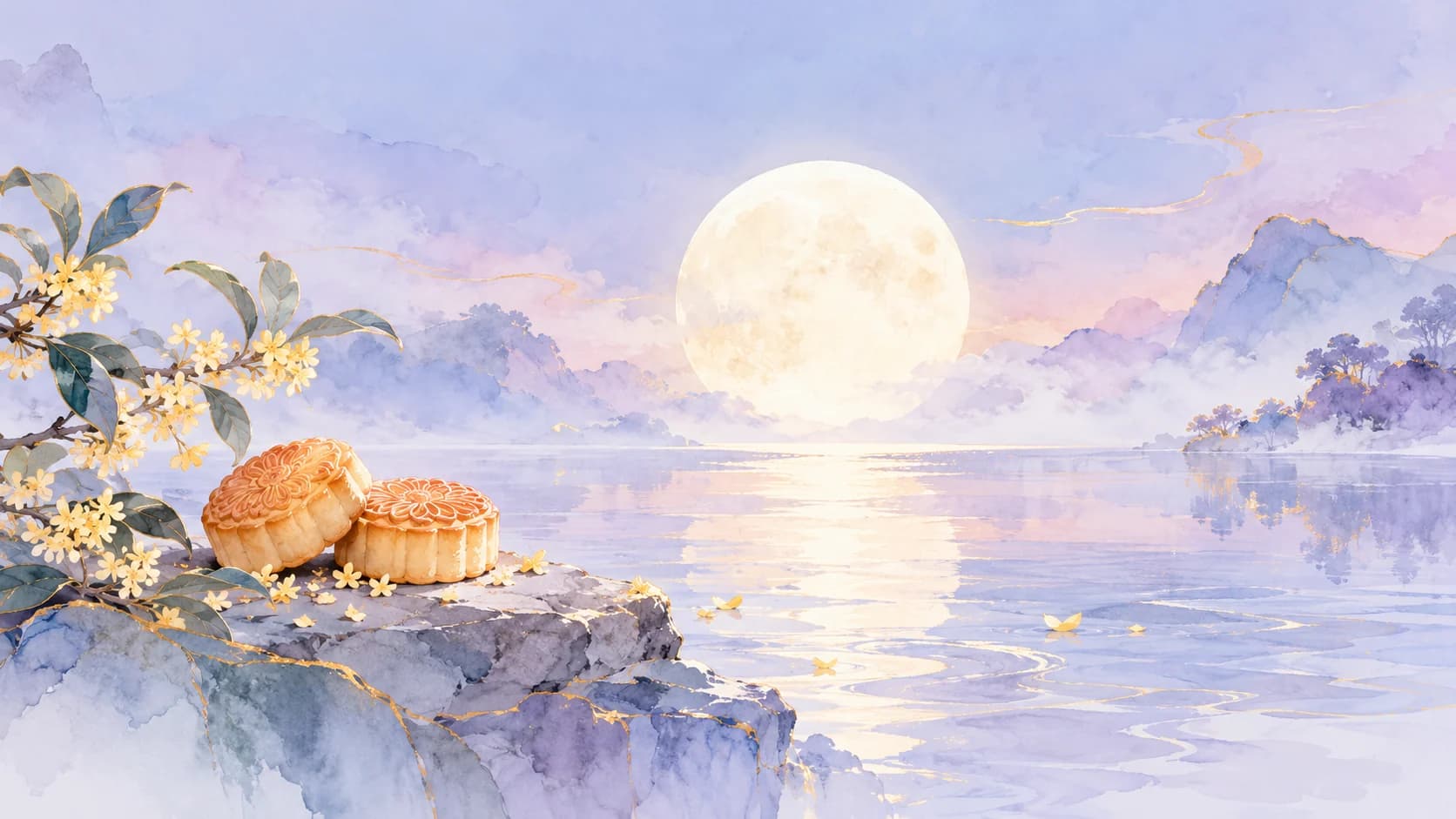
The Mid-Autumn Festival is a Chinese celebration of reunion, marked by sharing food, looking at the moon and spending time with family or friends. Mooncakes are its best-known food, but the occasion matters even to people who do not particularly like them: it offers a moment to reconnect, including with people far away.
In 2026, the festival fell on September 25. Mainland China’s public holiday runs September 25–27, separately from the October 1–7 National Day break. The festival follows the fifteenth day of the eighth month of the traditional lunar calendar, so its Gregorian date changes. Check the official 2026 holiday schedule when planning travel; our Golden Week guide explains the two holiday periods.
Why does the moon matter?
A full moon gives the festival a shared image of completeness and togetherness. Looking at the same moon can also express connection across distance. The Smithsonian’s Moon Festival teaching resource describes gatherings with food, poetry and music. You do not need to treat every celebration as a formal ceremony to understand that central idea.
How do people spend the festival?
A meal with family or friends, a gift of mooncakes, and an evening looking at the moon are familiar ways to celebrate. Households make their own choices about what to eat and how much ceremony to include. Someone working away from home may mark it with a call or a greeting rather than a journey back.
Mooncakes have sweet or savoury fillings and are associated with the festival’s round moon and reunion. If you are choosing some to share, ask which fillings your hosts enjoy and check the ingredients for anyone with dietary restrictions. Buying the most elaborate box is not a substitute for knowing the people you will share it with.
Public celebrations can include performances, lanterns and activities for children. They also tell a local story. In Philadelphia’s Chinatown festival, established in 1996, cultural performances and community organizing sit alongside the food and festivities. Smithsonian’s 2026 account shows how a celebration can carry both family memory and a neighborhood’s present-day concerns.
Joining in for the first time
| Your situation | A thoughtful way to take part |
|---|---|
| Invited to someone’s home | Ask about the meal time and whether bringing mooncakes, fruit or another contribution would be useful. |
| Visiting a public event | Check the organizer’s date and programme; community events need not fall on the festival day itself. |
| Greeting a friend from a distance | Send a personal message or arrange a call. Let their own way of celebrating guide the conversation. |
| Curious about a ritual or story | Ask what it means to your host. One person’s tradition does not represent every Chinese household. |
A simple Mandarin greeting is 中秋快乐 (Zhōngqiū kuàilè), “Happy Mid-Autumn Festival.” You can pair it with an ordinary wish to enjoy time together. There is no need to deliver a speech about traditions you are still learning.
From moon observance to a living festival
The festival developed over time rather than beginning with one documented family reunion. China.org.cn’s historical overview traces its development through the Tang period (618–907), its growth during the Song (960–1279), and its importance among major festivals in the Ming and Qing periods. That broad chronology is more useful than assigning every modern custom the same ancient origin.
Today, private meals, commercial mooncake gifts and public cultural programmes coexist. Celebrations outside China develop their own local forms too. The Philadelphia example shows this in practice: people can preserve a connection with inherited traditions while using the festival to bring a present-day community together.
Where does Chang’e fit into the story?
In the version retold by the Smithsonian, the archer Hou Yi shoots down nine of ten suns. His wife Chang’e later drinks an elixir of immortality and rises to the moon. Her separation from the earthly world gives the moon a human story of distance and longing. It is a legend associated with the festival, not a historical record of its founding. Different retellings may explain the characters’ choices differently.
Knowing the story helps you recognize moon-goddess imagery without reducing the whole occasion to a myth. A guest can enjoy the food and company without knowing every version; the story provides another way into the festival when curiosity follows.
What does Zhongqiu Jie mean?
| Chinese | Mandarin | Meaning in this phrase |
|---|---|---|
| 中 | zhōng | Middle |
| 秋 | qiū | Autumn |
| 节 / 節 | jié | Festival |
Together, 中秋节 (Zhōngqiū Jié) is the Mid-Autumn Festival. The name tells you when it belongs in the traditional seasonal calendar. The gatherings, foods and stories explain why that date means something to people. You may also see “Moon Festival” in English, reflecting its central image.
What to take with you
If you remember one thing, let it be reunion rather than a shopping list of festival foods. Ask the people around you how they celebrate, share something they will enjoy, and leave room to learn the story behind their customs. For more help with introductions and name order when meeting Chinese-speaking friends, see our guide to reading a Chinese name.