
Novak Djokovic’s return to Beijing after eleven years brings a familiar question back into view: what keeps him competing? The China Open’s September 28, 2026 press-conference account reports that winning remains a central goal. The setting is current; the conviction behind it has a much longer history.
‘Champion’ tells us what someone has achieved. A personal name can point to what drives them. For Djokovic, self-belief is a compelling starting point—because he has repeatedly named it himself. What would you put in a Chinese name: the aspiration, the work that sustains it, or the determination to keep improving?
His familiar Chinese transliteration is 德约科维奇 (Déyuēkēwéiqí). Here we explore three original Chinese personal-name proposals inspired by his public expressions of those values. These are SoulName editorial proposals, not names chosen, used or endorsed by Novak Djokovic.
A name can be a miniature self-portrait
Choosing a Chinese name gives you a compact way to express what matters to you. A meaningful image can become part of every introduction, carrying more than the sound of your original name.
There is a useful echo of the historical zì (字), or courtesy name. The Book of Rites connects receiving a courtesy name with entering adult social life. A modern chosen Chinese name serves a different role, but the comparison opens an interesting question: what should a name bring into view about its bearer? Here, his own public words give us a place to begin.
The value Djokovic keeps coming back to
On his official personal profile, Djokovic says: ‘Belief is the most common word to me, even more than hope.’ It sits beside his account of dreaming of Wimbledon and the number-one position. That is a more revealing naming clue than a trophy count: he presents belief in a goal as something that precedes the result.
He made the connection explicit in his January 27, 2019 Australian Open press conference, calling self-belief central to his success. In the same interview, he recalled questioning his level after elbow surgery. The impression we choose to foreground is conviction that can be rebuilt through adversity, rather than an athlete who never doubts himself.
In his 2023 60 Minutes interview, he describes mental strength as ‘something that comes with work,’ including recovering after difficult emotions.
The Australian Open transcript also shows him prioritizing continued improvement and his mental, physical and emotional well-being. His personal profile describes learning across different fields and applying that knowledge to everyday life. Together, these remarks suggest a coherent portrait: believe in the purpose, put it into practice, and keep developing. Those are the three naming directions below—our editorial reading of values he has expressed, rather than a ranking of everyone’s impression of him.
Shangzhi: give your aspiration weight
For the purpose-focused name, the Mencius, “Jin Xin,” part one, section 33 offers 尚志 (Shàngzhì). Asked what a scholar’s work should be, Mencius answers ‘尚志.’ The conversation then explains that aspiration through benevolence and right conduct. We borrow the emphasis on a purpose worth honoring and apply it to Djokovic’s expressed belief in his dream.
尚 means to esteem or honor; 志 can mean aspiration, purpose or determination. Together, our name reading is ‘honor your aspiration.’ It gives the goal dignity before there is a result to celebrate, making this the closest of the three choices to the self-belief he repeatedly describes.
Shàngzhì is serious and traditional in tone. Its two falling syllables give it a firm ending when spoken with Qiáo. That firmness is its appeal and its cost: it puts purpose in the foreground more strongly than warmth or playfulness. The phrase gives us a name image; it does not translate the English word “self-belief” literally.
Minxing: give belief something to stand on
For the practice-focused name, the Analects, 4.24 offers ‘敏於行’: being earnest or prompt in action. The passage pairs that with restraint in speech. The part we borrow is the energy directed into doing.
敏行 (Mǐnxíng) puts that idea into two characters. 敏 can suggest quickness or diligence; 行, read xíng here, means to act or carry out. Together, our reading is diligent action. In this portrait, confidence gains substance through practice: the name highlights what someone does in pursuit of a goal.
This is the most direct of the three choices as a daily value: do the work. It also asks a useful question of a personal name—would you rather announce the ambition or the way you pursue it? Its practical cost is pronunciation: 行 has several readings, so Mǐnxíng needs to be introduced clearly.
Hengxin: stay committed, keep learning
Continuing improvement gives the third name a productive tension. You can remain committed to a purpose while changing how you pursue it. The Great Learning encourages repeated renewal through ‘日日新,又日新,’ the idea of making oneself new day after day.
Pair 恒 (héng), lasting or constant, with 新 (xīn), new or renewal, and we get 恒新 (Héngxīn). The classical passage supplies the renewal inspiration; the pairing is our creation. Djokovic’s public emphasis on improvement makes this an image of a learner who keeps the purpose and renews the approach.
Héngxīn also sounds like 恒心, ‘perseverance,’ in Mandarin. That familiar echo gives the pairing another layer. This option is less forceful than 尚志 and less concrete than 敏行; it suits someone who wants persistence and openness to growth to appear together.
A surname brings the sound back to Djokovic
So far, these are given names. A Chinese full name places the family name first. For Đoković, 焦 (Jiāo) and 乔 (Qiáo) offer loose Mandarin echoes of the surname’s opening sound. The Serbian transcription reference identifies đ as a voiced affricate; neither Chinese surname reproduces it exactly.
Both are established surnames listed in the traditional Hundred Family Surnames. To our ear, Qiáo gives 尚志 and 恒新 a flowing entrance; Jiāo gives 敏行 a firmer opening. That leads to 乔尚志 (Qiáo Shàngzhì), 焦敏行 (Jiāo Mǐnxíng) and 乔恒新 (Qiáo Héngxīn). These choices keep a little sound connection without implying Chinese ancestry. Our Chinese surname guide explores the same decision for your own name.
Three Chinese name proposals
These are SoulName editorial proposals inspired by public information about Novak Djokovic. They are not names chosen, used, or endorsed by Novak Djokovic.
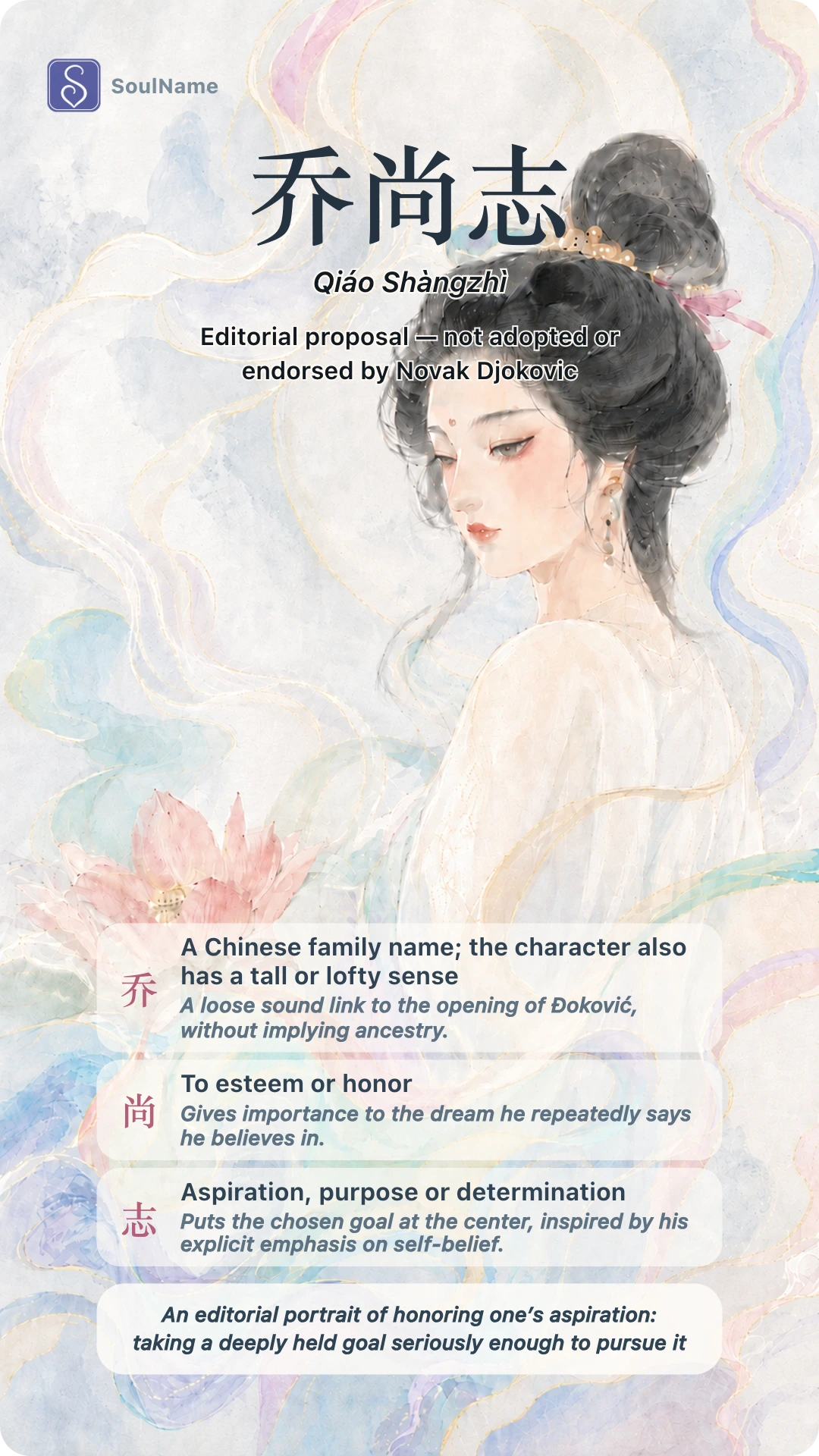
Read the full explanation for Qiáo Shàngzhì
乔尚志 · Qiáo Shàngzhì
- 乔 (Qiáo) — A Chinese family name; the character also has a tall or lofty sense
- A loose sound link to the opening of Đoković, without implying ancestry.
- 尚 (Shàng) — To esteem or honor
- Gives importance to the dream he repeatedly says he believes in.
- 志 (Zhì) — Aspiration, purpose or determination
- Puts the chosen goal at the center, inspired by his explicit emphasis on self-belief.
Whole-name meaning: An editorial portrait of honoring one’s aspiration: taking a deeply held goal seriously enough to pursue it
Trade-off: The most direct statement of purpose; its traditional, firm tone is more solemn than the other options. It expresses an aspiration, rather than literally translating self-belief.
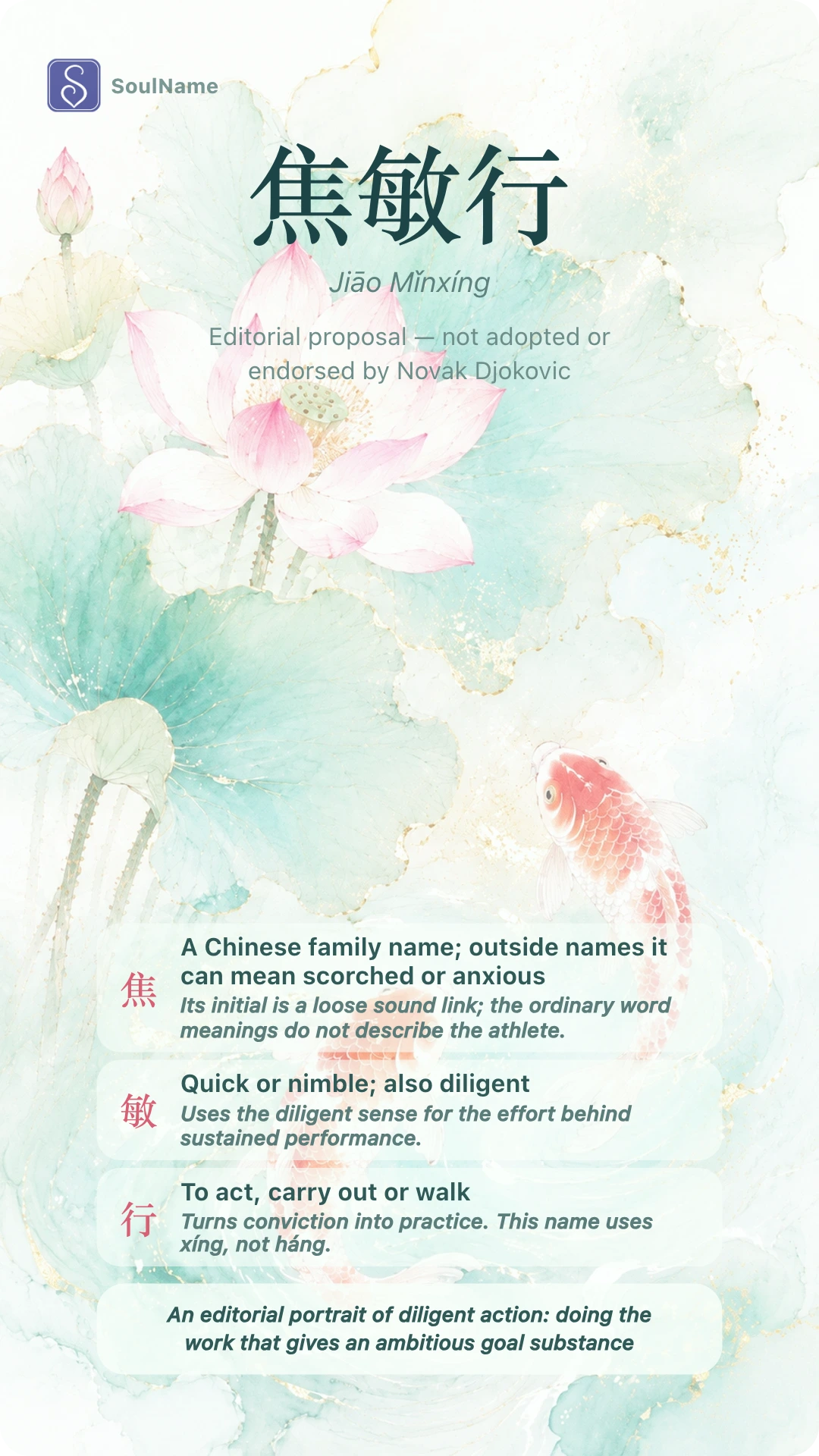
Read the full explanation for Jiāo Mǐnxíng
焦敏行 · Jiāo Mǐnxíng
- 焦 (Jiāo) — A Chinese family name; outside names it can mean scorched or anxious
- Its initial is a loose sound link; the ordinary word meanings do not describe the athlete.
- 敏 (Mǐn) — Quick or nimble; also diligent
- Uses the diligent sense for the effort behind sustained performance.
- 行 (Xíng) — To act, carry out or walk
- Turns conviction into practice. This name uses xíng, not háng.
Whole-name meaning: An editorial portrait of diligent action: doing the work that gives an ambitious goal substance
Trade-off: The most practical option; 行 has several readings, so the intended xíng needs to travel with the name.
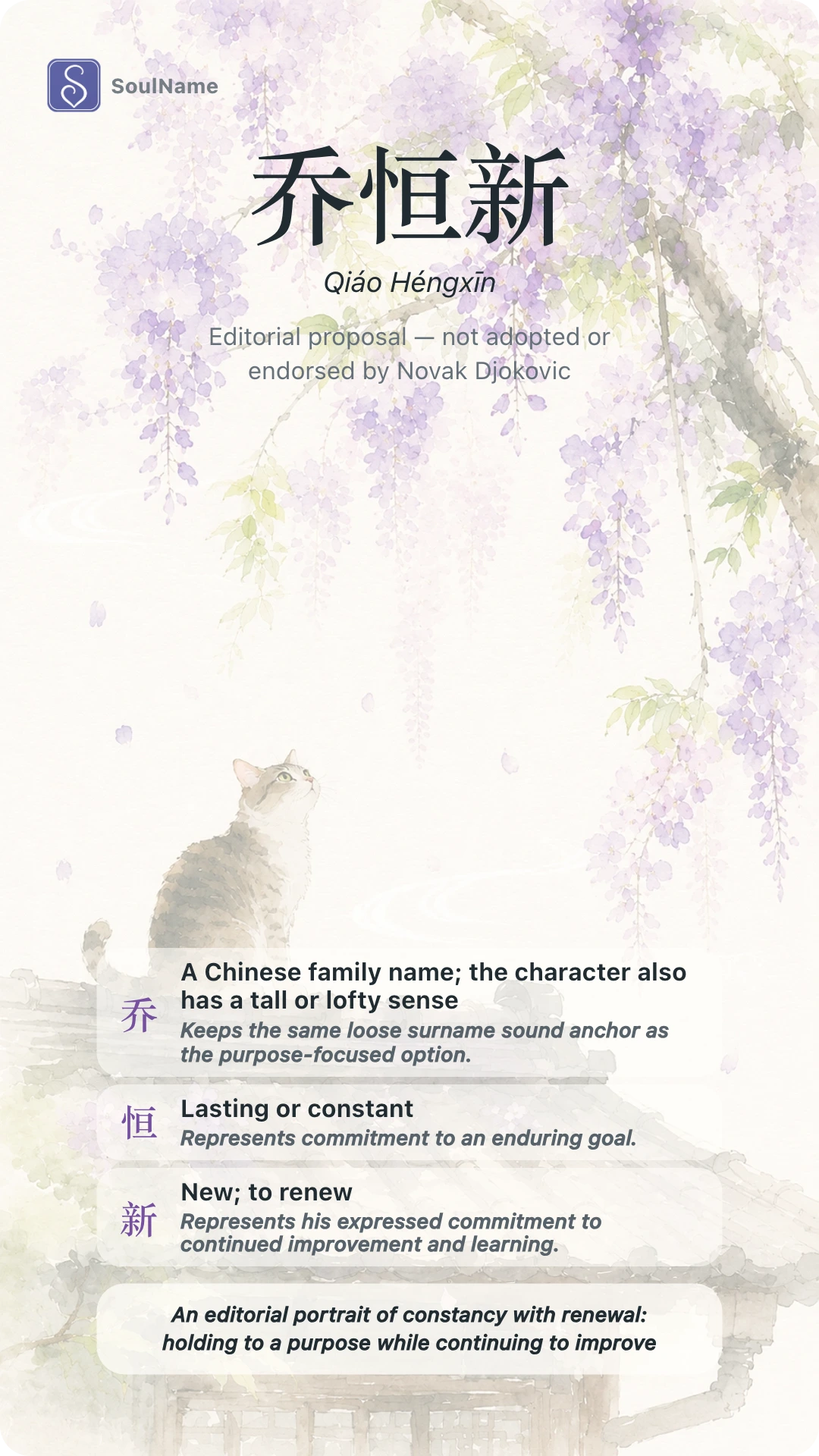
Read the full explanation for Qiáo Héngxīn
乔恒新 · Qiáo Héngxīn
- 乔 (Qiáo) — A Chinese family name; the character also has a tall or lofty sense
- Keeps the same loose surname sound anchor as the purpose-focused option.
- 恒 (Héng) — Lasting or constant
- Represents commitment to an enduring goal.
- 新 (Xīn) — New; to renew
- Represents his expressed commitment to continued improvement and learning.
Whole-name meaning: An editorial portrait of constancy with renewal: holding to a purpose while continuing to improve
Trade-off: The most abstract option; it echoes 恒心, perseverance, and the full name already appears in a public filing. Its renewal theme needs context.
Which value would you put in a name?
Our pick for this portrait of Djokovic is Qiáo Shàngzhì. It foregrounds the aspiration he says he believes in, before achievement turns it into a record. Choose Jiāo Mǐnxíng if the work behind that belief matters more to you. Choose Qiáo Héngxīn if you want the combination of persistence and continued learning to be the first impression.
For your own Chinese name, start with the value you want an introduction to carry. Then decide which side of it matters most: your purpose, your way of acting or your willingness to grow. Find characters that express that choice naturally, add a surname, and say the whole name aloud. You can explore your own Chinese name with SoulName when you have that starting point.
A note on the proposals: ‘original’ means independently developed for this exercise, not exclusive. The full name 乔恒新 also appears in a public corporate filing. Djokovic himself acknowledged a Chinese-name gift in a 2018 website post; that post’s text does not give the spelling. The three cards here belong to our editorial exercise.